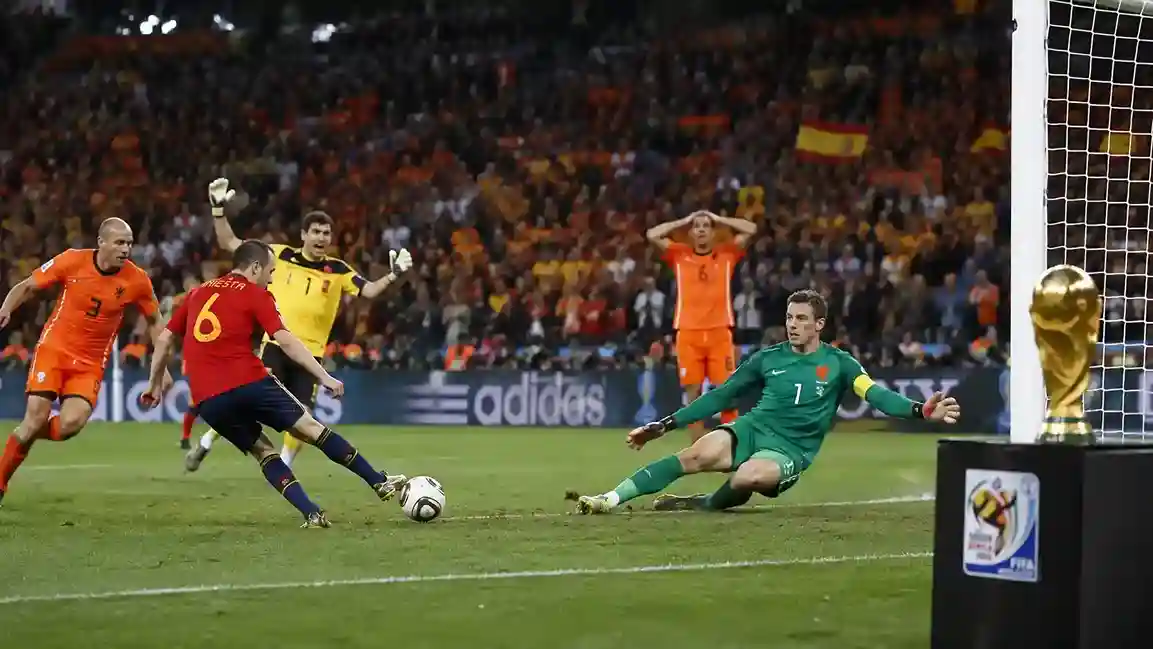
2010 FIFA WC: Iniesta Leads Spain to Victory Over Netherlands in Extra Time
Johannesburg, South Africa — On July 11, 2010, Spain captured its first World Cup title with a 1-0 extra-time victory over the Netherlands at Soccer City Stadium before 84,490 spectators.
The match, marred by a finals-record 14 yellow cards and a red card for Dutch defender John Heitinga, was decided in the 116th minute when Andrés Iniesta controlled a Cesc Fàbregas pass and fired past goalkeeper Maarten Stekelenburg.
The Dutch, seeking their first World Cup after losing finals in 1974 and 1978, employed a physical approach that disrupted Spain‘s passing rhythm but ultimately left them shorthanded. Spain, the European champions two years prior, became the eighth nation to lift the trophy and the first to win the World Cup after losing their opening group match to Switzerland.
Match Overview Table
| Information | Match Details |
| Event | 2010 FIFA World Cup Final |
| Game | Netherlands vs Spain |
| Date | July 11, 2010 |
| Venue | Soccer City Stadium, Johannesburg |
| Attendance | 84,490 |
| Winner | Spain |
| Final Score | 0–1 (AET) |
| Broadcast | ABC, ESPN, Univision |
Core Match Statistics Overview
| Metric | Netherlands | Spain |
| Possession | 43% | 57% |
| Shots | 13 | 19 |
| Shots on Target | 5 | 6 |
| Corners | 6 | 8 |
| Fouls Committed | 28 | 19 |
| Yellow Cards | 8 | 5 |
| Red Cards | 1 | 0 |
| Saves | 5 | 5 |
Possession Control
- Spain completed 57% of possession, starving the Dutch of meaningful attacking sequences.
- The Netherlands managed only 43% possession, their lowest of the knockout stage.
Shooting Efficiency
- Spain outshot the Netherlands 19 to 13, forcing Stekelenburg into five saves.
- The Dutch registered five shots on goal but failed to beat Iker Casillas, who delivered a decisive performance in goal.
Period-by-Period Analysis
First Half
| Team | Goals |
| Netherlands | 0 |
| Spain | 0 |
Spain controlled early possession, with Sergio Ramos twice testing Stekelenburg from headers and a low drive.- Nigel de Jong‘s 28th-minute chest stamp on Xabi Alonso escaped a red card, setting a physical tone.
- Arjen Robben nearly broke through in first-half stoppage time, but Casillas parried his effort.
Second Half
| Team | Goals |
| Netherlands | 0 |
| Spain | 0 |
Robben broke free twice on goal, but Casillas denied him with crucial saves in the 62nd and 83rd minutes.- Spain introduced Jesús Navas and Cesc Fàbregas to inject pace and creativity.
- Heitinga received his second yellow card in the 109th minute, reducing the Netherlands to 10 men.
Extra Time
| Team | Goals |
| Netherlands | 0 |
| Spain | 1 |
Fàbregas forced a save from Stekelenburg and hit wide as Spain pressed.- In the 116th minute, Fàbregas collected a loose ball and fed Iniesta, who struck from eight yards past Stekelenburg.
- The Netherlands could not respond, and Spain secured their first World Cup.
Detailed Player Statistics
Spain Player Statistics
Andrés Iniesta
- Minutes: 118
- Goals: 1
- Shots: 3
- Key Contributions: Match-winner in the 116th minute; Spain’s most consistent attacking threat.
Iker Casillas
- Minutes: 120
- Saves: 5
- Clean Sheet: Yes
- Key Contributions: Two critical one-on-one stops against Robben that preserved the shutout.
Xavi Hernández
- Minutes: 120
- Pass Completion: Tournament-best orchestrator
- Key Contributions: Controlled midfield tempo, completed 94 passes, and kept Spain composed through Dutch pressure.
Cesc Fàbregas
- Minutes: 66 (substitute)
- Assists: 1
- Key Contributions: Provided the assist for Iniesta’s winner and transformed Spain‘s attacking urgency after entering.
Netherlands Player Statistics
Arjen Robben
- Minutes: 120
- Shots: 4
- Key Contributions: Created the Netherlands’ best chances but failed to convert two clear one-on-one opportunities against Casillas.
Wesley Sneijder
- Minutes: 120
- Goals: 0
- Key Contributions: Tournament‘s joint-top scorer (5 goals) was largely neutralized by Spain’s midfield press.
Maarten Stekelenburg
- Minutes: 120
- Saves: 5
- Key Contributions: Kept the Netherlands alive with multiple stops before Iniesta‘s late breakthrough.
John Heitinga
- Minutes: 109
- Red Card: 1 (second yellow)
- Key Contributions: Dismissal left the Netherlands shorthanded for the final 11 minutes, opening space for Spain’s winner.
Statistical Leaders Summary Table
| Category | Netherlands | Spain |
| Leading Scorer (Tournament) | Wesley Sneijder (5) | David Villa (5) |
| Second Leading Scorer | Arjen Robben (2) | Andrés Iniesta (2) |
| Top Defender/Goalkeeper | Maarten Stekelenburg (5 saves) | Iker Casillas (5 saves) |
| Most Creative Player | Wesley Sneijder | Xavi Hernández |
Analytical Breakdowns
Why Spain Won
Midfield Dominance
Spain‘s 57% possession translated into 19 shot attempts versus 13 for the Netherlands. The midfield trio of Xavi, Busquets, and Alonso completed more passes than the entire Dutch midfield, rendering Sneijder and Robben isolated for long stretches.
| Metric | Netherlands | Spain |
| Possession | 43% | 57% |
| Total Shots | 13 | 19 |
| Shots on Target | 5 | 6 |
Defensive Resilience
Casillas delivered five saves, including two critical stops against Robben that would have changed the match‘s complexion. Spain’s back four absorbed 28 Dutch fouls and kept their composure through extra time.
Impact Substitutions
Del Bosque‘s introduction of Fàbregas and Navas in the second half shifted momentum. Fàbregas provided the assist for the winner, while Navas stretched the Dutch defense with direct running.
Why the Netherlands Lost
Physical Approach Backfired
The Netherlands committed 28 fouls and received eight yellow cards before Heitinga’s dismissal. Their aggressive tactics disrupted Spain but left them exposed in extra time when legs tired and space opened.
Wasteful Finishing
Robben‘s two one-on-one opportunities against Casillas were the Netherlands’ best chances. Converting either would have forced Spain to chase the game and altered the tactical landscape entirely.
Inability to Sustain Pressure
After a strong start to the second half, the Netherlands faded in extra time. Spain‘s superior fitness and ball retention forced the Dutch to chase shadows, culminating in Iniesta’s breakthrough.
Historical Context & Advanced Insights
Tournament Route Comparison
| Round | Netherlands | Spain |
| Group Stage | 3 Wins | 2 Wins, 1 Loss |
| Round of 16 | 2–1 vs Slovakia | 1–0 vs Portugal |
| Quarterfinal | 2–1 vs Brazil | 1–0 vs Paraguay |
| Semifinal | 3–2 vs Uruguay | 1–0 vs Germany |
The Netherlands entered the final unbeaten, while Spain had lost their opener to Switzerland before grinding through four consecutive 1–0 victories.
Assist-to-Goal Efficiency
Fàbregas‘s assist for Iniesta came from just his 66 minutes of tournament action—a microcosm of Spain’s depth. The Netherlands, by contrast, relied heavily on Sneijder (5 goals) and Robben (2 goals), who accounted for seven of their eight tournament goals before the final.
Game Implications & Key Lessons
What This Means for Spain
- Spain became the first team since Brazil in 1970 to win the World Cup after losing their group-stage opener.
- The victory completed a European Championship–World Cup double, cementing their status as the era‘s dominant international side.
- The core of this squad would go on to win Euro 2012, achieving an unprecedented international treble.
What This Means for the Netherlands
- The Netherlands became the first nation to lose three World Cup finals (1974, 1978, 2010).
- Their physical approach drew widespread criticism and overshadowed the attacking talent of Sneijder and Robben.
- The defeat marked the end of the Bert van Marwijk era’s best chance at a major trophy.
Key Lessons
- Possession without penetration requires patience; Spain‘s winner came in the 116th minute after relentless pressure.
- Physical intimidation cannot compensate for technical inferiority in extended matches.
- Goalkeepers win finals—Casillas’s saves were as decisive as Iniesta‘s goal.
- Substitutions matter: Fàbregas’s 66-minute contribution proved more impactful than any Dutch bench option.
- Disciplinary discipline is non-negotiable; Heitinga‘s dismissal directly preceded the winning goal.
FAQs
Who won the 2010 FIFA World Cup?
Spain won their first World Cup title, defeating the Netherlands 1–0 in extra time.
In the 2010 World Cup final, who scored the winning goal?
Andrés Iniesta scored in the 116th minute, assisted by Cesc Fàbregas.
What were Andrés Iniesta’s stats in the final?
Iniesta played 118 minutes, scored one goal, and registered three shots, including the match-winner.
In the 2010 World Cup final, how many yellow cards were issued?
Referee Howard Webb issued a finals-record 14 yellow cards—eight to the Netherlands and five to Spain—plus one red card to John Heitinga.
What was the attendance for the 2010 World Cup final?
84,490 spectators attended at Soccer City Stadium in Johannesburg.
Did the Netherlands finish the final with 10 men?
Yes, John Heitinga received a second yellow card in the 109th minute and was sent off.
Conclusion
Spain‘s 2010 World Cup triumph was not a display of breathtaking attacking football but a masterclass in patience, control, and defensive resilience. The Netherlands’ aggressive approach neutralized Spain‘s tiki-taka for 115 minutes, but Heitinga’s dismissal and Fàbregas‘s introduction finally cracked the Dutch resistance.
Iniesta’s composed finish rewarded Spain‘s persistence and completed a journey that began with an opening-match defeat. For the Netherlands, it was a third final lost, and the tactical lesson was clear: physicality alone cannot overcome technical excellence sustained over 120 minutes.