Brazil National Football Team vs Chile National Football Team Lineups: Estêvão and Paquetá Power Seleção to Cruise Past La Roja
Qualifying campaigns can turn on nights when a favorite simply has to show up and finish the job, and that’s exactly the test Brazil faced against Chile. The problem: a shaky Seleção side had dropped points against lesser opposition all cycle.
The agitation: anything less than a shutdown home performance would keep the pressure on Carlo Ancelotti. The solution arrived in the second half, as Brazil’s front line turned control of the ball into three clean finishes and a comfortable 3-0 win.
The Lead
Brazil hosted Chile at the legendary Maracanã in Rio de Janeiro on Thursday, September 4, 2025 (early hours of September 5 UTC), in matchday 17 of the CONMEBOL World Cup qualifying group.
A crowd of 57,326 packed the stadium to watch a fixture that carried more symbolic than mathematical weight — Brazil had already booked its ticket to the 2026 World Cup, while Chile had long been eliminated from contention. Referee Alexis Herrera oversaw a match that finished Brazil 3, Chile 0.
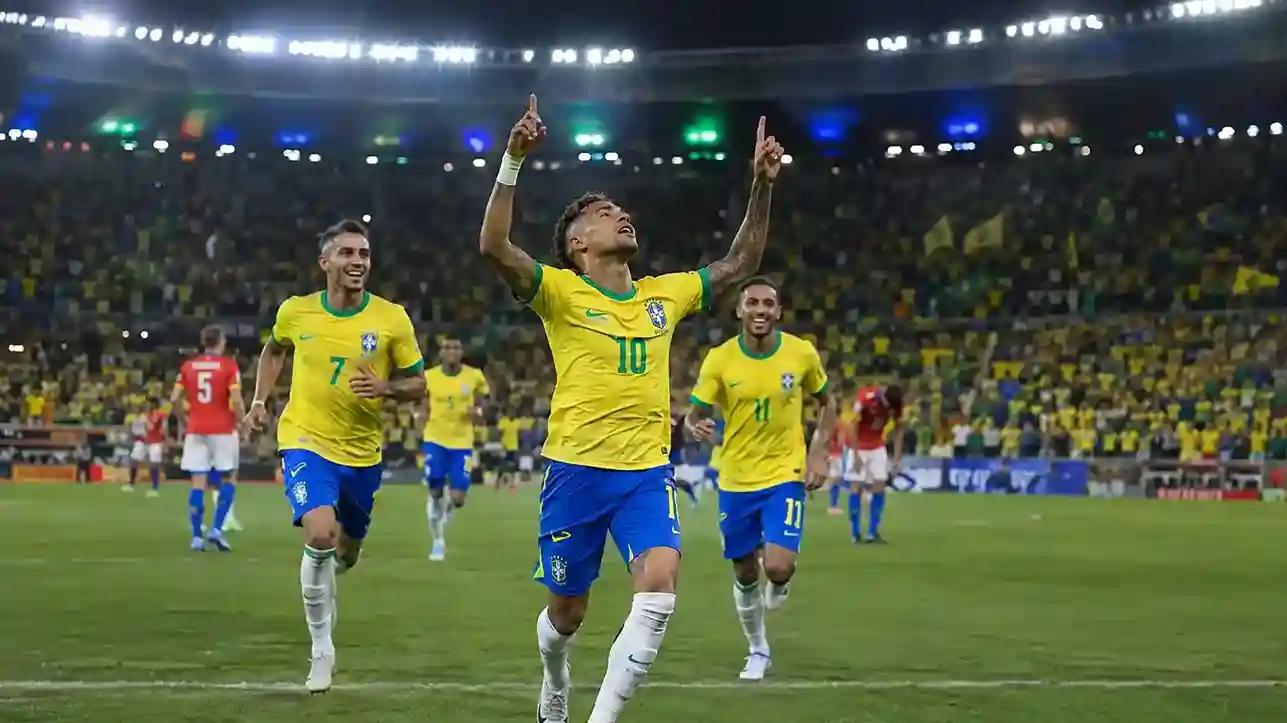
The hosts dominated the ball from kickoff but couldn’t find the breakthrough until the 38th minute, when 18-year-old Estêvão scored his first senior international goal with an acrobatic finish after Raphinha’s initial effort was blocked.
Chile held on defensively for long stretches, but Brazil’s pressure eventually told: Lucas Paquetá doubled the lead in the 72nd minute off a Luiz Henrique assist, and Bruno Guimarães added a third four minutes later to put the result beyond doubt.
Match Overview Table
| Information | Match Details |
| Event | 2026 FIFA World Cup Qualifiers – CONMEBOL (Matchday 17) |
| Game | Brazil vs Chile |
| Date | September 4, 2025 (kickoff 8:30 PM local / Sept 5, 00:30 UTC) |
| Venue | Estádio Jornalista Mário Filho (Maracanã), Rio de Janeiro |
| Attendance | 57,326 |
| Winner | Brazil |
| Final Score | 3-0 |
| Broadcast | Regional CONMEBOL qualifying broadcasters (varies by market) |
Core Match Statistics Overview
Anyone searching for how the Brazil national football team vs Chile national football team lineups actually performed on the pitch will find the underlying numbers tell a lopsided story well before the scoreline caught up.
| Metric | Brazil | Chile |
| Possession | 63.8% | 36.2% |
| Total Shots | 22 | 3 |
| Shots on Target | 7 | 0 |
| Expected Goals (xG) | 4.14 | 0.07 |
| Corner Kicks | 4 | 3 |
| Fouls Committed | 14 | 11 |
| Tackles | 15 | 15 |
| Yellow Cards | 1 | 1 |
| Goalkeeper Saves | 0 | 3 |
Shot Volume and Quality
- Brazil out-shot Chile by a staggering 22-3 margin, and the expected-goals gap (4.14 to 0.07) shows the chances weren’t just plentiful, they were high quality.
- Chile never registered a shot on target across 90-plus minutes, a clear sign the visitors’ defensive block absorbed pressure but never generated a real attacking outlet of their own.
Ball Progression and Territory
- Brazil’s near two-thirds share of possession let Ancelotti’s side dictate tempo and repeatedly probe Chile’s back three.
- Chile’s 36.2% possession share came mostly in deep, low-danger areas, which explains why their expected-goals total barely registered.
Physical Duels and Discipline
- Despite the gulf in possession, both sides finished with an identical 15 tackles, showing Chile committed bodies to stop Brazil’s ball carriers even while conceding territory.
- Card counts stayed even at one yellow apiece — Casemiro for Brazil in first-half stoppage time and Guillermo Maripán for Chile — keeping the game largely clean given the physical duels.
Set-Piece Threat
- Brazil edged the corner count 4-3, but none of their goals came directly from a dead ball, underlining that this win was built on open-play combination play rather than set-piece rehearsal.
- Chile’s three corners produced no shots on target, mirroring their broader struggle to convert territory into danger.
Period-by-Period Analysis
First Half
| Period | Brazil | Chile |
| Goals | 1 | 0 |
| Key Moment | Estêvão goal, 38′ | Maripán yellow card, 45+3′ |
- Brazil started fast and thought they had an early lead when Casemiro headed home inside five minutes, only for the effort to be ruled out for offside.
- The Seleção kept generating chances but couldn’t beat Lawrence Vigouroux until Estêvão’s spectacular finish in the 38th minute, following a blocked Raphinha attempt.
- Casemiro picked up a yellow card deep into first-half stoppage time, a minor blemish on an otherwise controlled 45 minutes for the hosts.
Second Half
| Period | Brazil | Chile |
| Goals | 2 | 0 |
| Key Moment | Paquetá 72′, Guimarães 76′ | Late substitutions, no response |
- Chile made an early second-half change, bringing on Gonzalo Tapia for Ben Brereton Díaz in the 59th minute to try to add a spark up top, but the visitors still couldn’t test Alisson.
- Brazil’s double substitution in the 66th minute — Luiz Henrique for Casemiro and Andrey Santos for Estêvão — refreshed the attack, and it paid off almost immediately.
- Two goals in five minutes, Paquetá in the 72nd and Guimarães in the 76th, turned a nervy 1-0 scoreline into a comfortable laugher and let Ancelotti rotate late with Kaio Jorge and Richarlison also entering the match.
Brazil Player Statistics
Estêvão (Forward)
- Goals: 1, Shots: 4, Shots on Target: 1
The 18-year-old Chelsea forward scored the game’s opening goal with an acrobatic strike and was Brazil’s most direct attacking threat before his 66th-minute withdrawal, tying for the team lead in shots taken.
Raphinha (Winger)
- Goals: 0, Shots: 4, Shots on Target: 1
Raphinha’s blocked effort created the rebound that led to Estêvão’s opener, and he matched the team high in shot volume, staying involved in Brazil’s attack until he was substituted late for Richarlison.
Lucas Paquetá (Midfielder)
- Goals: 1, Assists: 0, Shots on Target: 1
Paquetá got on the scoresheet in the 72nd minute, finishing a Luiz Henrique assist to double Brazil’s advantage and settle any lingering nerves in the stadium.
Bruno Guimarães (Midfielder)
- Goals: 1, Fouls Drawn: multiple, Shots on Target: 1
Guimarães capped the scoring with a 76th-minute finish and was a constant presence in midfield distribution, helping Brazil control tempo for most of the night.
Chile Player Statistics
Lucas Cepeda (Winger)
- Shots: 3 (team high), Shots on Target: 0
Cepeda was Chile’s primary source of attacking intent, taking three of the team’s three total shots, though none forced a save from Alisson.
Fabián Hormazábal (Midfielder)
- Tackles: 3 (tied team high), Fouls Committed: multiple
Hormazábal was central to Chile’s defensive effort out wide, tying for the team lead in tackles as La Roja tried to slow Brazil’s wide combinations.
Paulo Díaz (Center Back)
- Fouls Committed: 3 (team high), Tackles: multiple
Díaz anchored a back line that faced 22 shots, committing the most fouls on the Chilean side as he repeatedly had to stop Brazilian attackers in dangerous areas.
Guillermo Maripán (Center Back)
- Yellow Cards: 1, Tackles: 3 (tied team high)
Maripán picked up Chile’s only booking of the night and also tied for the team lead in tackles, reflecting how much defensive work fell on the back three all match.
Statistical Leaders Summary Table
| Category | Brazil | Chile |
| Leading Scorer | Estêvão (1 goal) | — |
| Second Leading Scorer | Lucas Paquetá (1 goal) | — |
| Top Shot Volume | Raphinha / Estêvão (4 shots each) | Lucas Cepeda (3 shots) |
| Most Tackles | Douglas Santos (3) | Hormazábal / Román / Suazo (3 each) |
Why Brazil Won
Overwhelming Shot Volume
Brazil’s 22 shots to Chile’s 3 meant the hosts only needed reasonable finishing to eventually break through, and that’s exactly what happened after halftime.
| Stat | Brazil | Chile |
| Total Shots | 22 | 3 |
| Shots on Target | 7 | 0 |
Effective Bench Impact
Substitutes Luiz Henrique and Andrey Santos entered in the 66th minute and directly changed the game’s rhythm, with Luiz Henrique assisting Paquetá’s goal just six minutes after coming on.
Control of Territory and Tempo
A 63.8% possession share let Brazil dictate where and when the game was played, wearing down a Chile side that had to defend for the majority of the match.
Why Chile Lost
Toothless Final Third
Zero shots on target across 90-plus minutes is the clearest marker of Chile’s attacking night — the visitors simply couldn’t turn defensive stops into transition chances.
Overreliance on Individual Duels
With Cepeda taking all three of the team’s shots, Chile lacked a second attacking outlet, making their offense easy to key on once Brazil settled defensively.
Historical Context & Advanced Insights
Recent Head-to-Head Results
| Date | Result |
| Oct 10, 2024 | Chile 1-2 Brazil |
| Mar 24, 2022 | Brazil 4-0 Chile |
| Sep 2, 2021 | Chile 0-1 Brazil |
| Jul 2, 2021 | Brazil 1-0 Chile |
| Oct 10, 2017 | Brazil 3-0 Chile |
Brazil had won each of its previous five meetings with Chile heading into this qualifier, and the September 2025 result extended that streak with the largest margin of victory in the run.
Shot Efficiency Breakdown
Brazil converted 3 of 22 total shots (roughly 13.6%) and 3 of 7 shots on target (a strong 43%) into goals, a conversion rate that reflects genuinely high-quality chances rather than simple shot-volume padding — backed up by the 4.14 expected-goals figure recorded for the match. Chile, by contrast, generated an expected-goals total of just 0.07, essentially confirming the eye test that the visitors never threatened a genuine equalizer.
Game Implications & Key Lessons
What This Means for Brazil
- The win moved the Seleção up to second place in the qualifying table with 28 points, adding momentum before the final matchday trip to Bolivia.
- Goals from three different attacking players (Estêvão, Paquetá, Guimarães) suggest Ancelotti has more than one reliable scoring outlet heading toward 2026.
- A first senior goal for teenager Estêvão on home soil is a confidence marker the coaching staff can build around.
What This Means for Chile
- The result confirmed a difficult qualifying cycle, with La Roja finishing at the bottom of the group and already eliminated from World Cup contention.
- Zero shots on target highlights the urgent need for Chile to develop more attacking depth beyond isolated individual efforts like Cepeda’s.
- The generational transition already underway, with veterans left out of the squad, will need faster development from younger attacking players.
Key Lessons
- Shot volume matters, but shots on target and expected goals tell the real story of chance quality.
- Bench substitutions made at the right moment, like Brazil’s double change in the 66th minute, can directly manufacture goals.
- A dominant possession share only translates into wins when it’s paired with genuine shot quality in the final third.
- Defensive resilience alone, as Chile showed for long stretches, can’t offset a complete lack of attacking output.
- Individual moments of quality, such as Estêvão’s acrobatic finish, often unlock otherwise stubborn defensive setups.
- Head-to-head history and recent form both pointed toward this result, reinforcing how useful trend data can be before a match.
FAQs
Who won the Brazil vs Chile match?
Brazil won 3-0 over Chile at the Maracanã in Rio de Janeiro on September 4, 2025.
Who scored the goals for Brazil?
Estêvão opened the scoring in the 38th minute, followed by Lucas Paquetá in the 72nd minute and Bruno Guimarães in the 76th minute.
What were the final shot statistics?
Brazil finished with 22 total shots and 7 on target, while Chile managed just 3 shots and none on target.
Did Chile have any real scoring chances?
Chile’s expected-goals total for the match was only 0.07, and the team registered zero shots on target, indicating very limited attacking threat throughout the game.
What was the attendance for this match?
A crowd of 57,326 attended the game at the Maracanã.
How did this result affect the World Cup qualifying standings?
The win lifted Brazil to second place in the CONMEBOL qualifying table with 28 points, while Chile remained at the bottom of the group, already eliminated from World Cup contention.
Conclusion
Brazil’s win over Chile came down to a simple equation: control the ball, generate high-quality chances, and let individual talent finish the job once the opponent’s resistance wore down. Chile’s defense held admirably for large stretches but never had the attacking pieces to make Brazil pay for any lapses, and once the Seleção’s substitutes injected fresh energy after the hour mark, the result was never really in doubt.