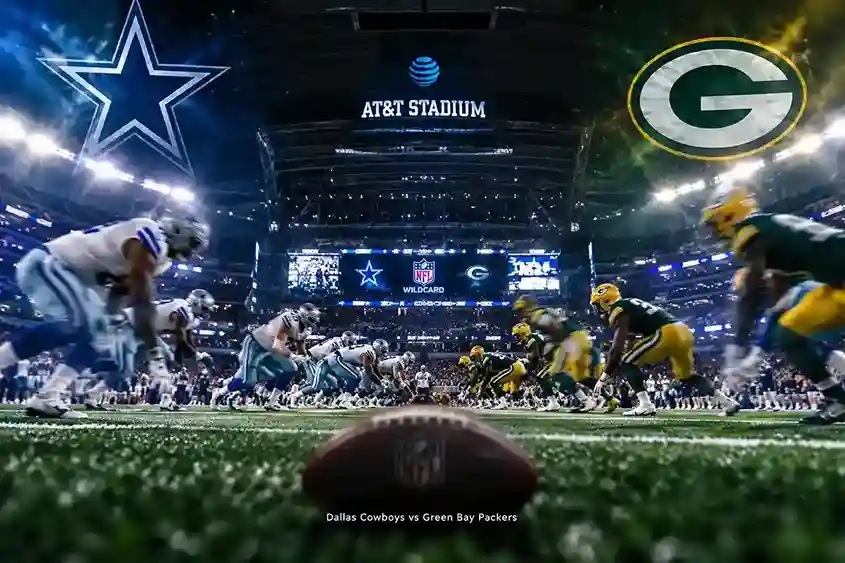
Dallas Cowboys vs Green Bay Packers: Jordan Love’s 3-TD Masterclass Seals Wild Card Victory
The NFC Wild Card matchup on January 14, 2024, at AT&T Stadium was supposed to be a coronation for the Dallas Cowboys after a 12-win regular season. Instead, the Green Bay Packers delivered a shocking statement, securing a 48-32 victory in front of a stunned crowd of 93,799 fans. The game was won through sheer offensive efficiency and defensive opportunism by the visitors, spearheaded by quarterback Jordan Love’s surgical passing display.
Green Bay established dominance immediately, exploiting Dallas’ defensive miscommunication to build a 27-point lead before halftime. While the Cowboys offense found statistical volume in garbage time, the Packers controlled the line of scrimmage, forced critical turnovers, and never allowed the home team to make it a one-possession game in the second half.
2. Match Overview Table
| Information | Match Details |
| Event | NFC Wild Card Playoffs |
| Game | Dallas Cowboys vs Green Bay Packers |
| Date | January 14, 2024 |
| Venue | AT&T Stadium (Arlington, TX) |
| Attendance | 93,799 |
| Winner | Green Bay Packers |
| Final Score | Packers 48, Cowboys 32 |
| Broadcast | FOX |
3. Core Match Statistics Overview
The final box score tells a story of a Green Bay offense that could not be stopped on early downs and a Dallas defense that failed to generate pressure or takeaways.
| Team Metric | Green Bay Packers | Dallas Cowboys |
| First Downs | 27 | 30 |
| Total Yards | 415 | 510 |
| Passing Yards | 272 | 387 |
| Rushing Yards | 143 | 123 |
| Turnovers | 0 | 2 |
| Sacks Against | 1 | 4 |
| Time of Possession | 30:45 | 29:15 |
| Third Down Efficiency | 6-10 | 7-14 |
Rushing Offense Disparity
The ground game set the tone for Green Bay, allowing them to control the clock and keep the Dallas pass rush off balance.
- Aaron Jones averaged a staggering 5.6 yards per carry, consistently gashing the interior of the Cowboys’ defensive line.
- The Packers out-rushed the Cowboys 143 to 123, with 96 of those yards coming in the decisive first half.
Third Down Dominance
Green Bay’s ability to extend drives was the ultimate momentum killer for the home crowd.
- The Packers converted 60% of their third-down attempts, primarily through short, manageable third-down situations created by effective play-action.
- Dallas’ defense, typically reliant on situational stops, failed to get off the field, allowing Green Bay to control the tempo.
Turnover Battle
In a playoff game featuring high-powered offenses, the turnover margin was decisive.
- Green Bay played a clean game with zero turnovers, forcing Dallas to drive the length of the field on every possession.
- Dallas committed two turnovers—both interceptions thrown by Dak Prescott—one of which was returned for a touchdown.
4. Period-by-Period Analysis
First Half: The Packer Blitz
| Period | Green Bay | Dallas |
| 1st Quarter | 7 | 0 |
| 2nd Quarter | 20 | 7 |
| Total | 27 | 7 |
Defensive Breakdown: Dallas cornerback DaRon Bland was beaten twice early, including a 75-yard completion to Romeo Doubs, exposing a soft zone scheme.- Offensive Identity: Jordan Love looked like a veteran, utilizing play-action to find open receivers in the middle of the field against a confused Dallas secondary.
- Turning Point: Darnell Savage’s 64-yard pick-six late in the second quarter took the wind out of the stadium and silenced the home crowd.
Third Quarter: The Cowboys Push Back
| Period | Green Bay | Dallas |
| 3rd Quarter | 7 | 9 |
Desperation Mode: Dallas opened the half with a much-needed tempo offense, resulting in a Jake Ferguson touchdown to cut the deficit.- Containment: Green Bay’s offense stalled for a brief moment, but they managed to answer with a Jordan Love touchdown pass to Luke Musgrave.
- Missed Opportunities: Dallas failed to convert a two-point conversion and missed a field goal attempt, leaving points off the board that were vital for a comeback.
Fourth Quarter: Garbage Time Volume
| Period | Green Bay | Dallas |
| 4th Quarter | 14 | 16 |
Stat Padding: Dak Prescott threw for over 150 yards in the final quarter against a soft prevent defense, inflating his final passing totals.- The Knockout Blow: Aaron Jones’ third rushing touchdown of the day officially ended any hopes of a miracle comeback.
- Finality: Green Bay’s offense continued to move the chains, ending the game in victory formation after draining the clock.
5. Detailed Team Player Statistics
Green Bay Packers Player Statistics
Jordan Love (QB)
| Statistic | Value |
| Completions/Attempts | 16/21 |
| Passing Yards | 272 |
| Touchdowns | 3 |
| Interceptions | 0 |
| Passer Rating | 157.2 |
Jordan Love delivered one of the greatest postseason debuts in Packers history. He was decisive, accurate, and showed zero fear against a top-tier pass rush, consistently finding the soft spots in the Dallas zone coverage.
Aaron Jones (RB)
| Statistic | Value |
| Rushing Attempts | 21 |
| Rushing Yards | 118 |
| Rushing Touchdowns | 3 |
| Receptions | 1 |
| Receiving Yards | 13 |
Jones was the engine of the entire offense. His vision and burst through the hole kept Green Bay ahead of the sticks all afternoon, allowing Matt LaFleur to dictate the terms of the engagement.
Romeo Doubs (WR)
| Statistic | Value |
| Receptions | 6 |
| Receiving Yards | 151 |
| Touchdowns | 1 |
| Targets | 8 |
Doubs dominated the matchup against the Cowboys’ secondary, particularly on deep crossing routes. His 75-yard reception in the first quarter set the tone for the entire game.
Darnell Savage (S)
| Statistic | Value |
| Tackles | 4 |
| Interceptions | 1 |
| Touchdowns | 1 |
| Passes Defended | 1 |
Savage’s pick-six was the single most impactful defensive play of the game. He read Prescott’s eyes perfectly, jumping the route and taking it to the house to make it a 27-point game.
Dallas Cowboys Player Statistics
Dak Prescott (QB)
| Statistic | Value |
| Completions/Attempts | 41/60 |
| Passing Yards | 403 |
| Touchdowns | 3 |
| Interceptions | 2 |
| Passer Rating | 89.6 |
Prescott’s raw passing yards look impressive, but the majority came after the game was out of reach. His two first-half interceptions directly led to 14 points for Green Bay.
CeeDee Lamb (WR)
| Statistic | Value |
| Receptions | 9 |
| Receiving Yards | 110 |
| Touchdowns | 1 |
| Targets | 17 |
Lamb was the only consistent offensive weapon for Dallas. He fought for yards after the catch, but the volume of targets (17) highlighted the lack of secondary options in the passing game.
Jake Ferguson (TE)
| Statistic | Value |
| Receptions | 10 |
| Receiving Yards | 93 |
| Touchdowns | 3 |
| Targets | 14 |
Ferguson was a reliable security blanket in the red zone, hauling in three touchdowns. However, his production was largely necessitated by the fact that the Cowboys were forced to abandon the run early.
Micah Parsons (LB)
| Statistic | Value |
| Tackles | 4 |
| Sacks | 1 |
| Tackles for Loss | 1 |
| QB Hits | 1 |
Despite the loss, Parsons was disruptive when given the chance. He recorded a sack and a tackle for loss, but the Green Bay game plan successfully neutralized him by running the ball directly at him with heavy personnel sets.
6. Statistical Leaders Summary Table
| Category | Green Bay Packers | Dallas Cowboys |
| Leading Scorer | Aaron Jones (18 pts) | Jake Ferguson (18 pts) |
| Second Leading Scorer | Romeo Doubs (6 pts) | Brandin Cooks (6 pts) |
| Top Rebounder/Defense | Quay Walker (9 tackles) | Markquese Bell (10 tackles) |
| Most Assists/Playmaker | Jordan Love (3 TDs) | Dak Prescott (3 TDs) |
7. Analytical Breakdowns (“Why They Won / Why They Lost”)
Why the Green Bay Packers Won
Early Down Passing Success
Green Bay didn’t wait for third down to attack the sticks. They threw the ball aggressively on first and second down, catching Dallas in base defensive personnel.
| Statistic | Packers | Cowboys |
| First Half Passing Yards | 185 | 108 |
| First Half Touchdowns | 3 | 1 |
Offensive Line Dominance
The Packers’ offensive line, often criticized during the regular season, manhandled the Cowboys’ front seven. They allowed only one sack and created massive running lanes.
- Key Win: Right tackle Zach Tom silenced Micah Parsons in the first half without requiring constant double-team help.
- Result: Jordan Love was pressured on only 15% of his dropbacks.
Why the Dallas Cowboys Lost
Defensive Communication Errors
The Cowboys’ secondary looked lost against motion and play-action. Multiple breakdowns led to wide-open receivers downfield.
- The Bland Blunder: All-Pro cornerback DaRon Bland had his worst game of the season, getting beat on a double move for a long score and missing tackles in the open field.
- Gap Discipline: Dallas’ interior defensive line frequently lost gap integrity, allowing Aaron Jones to cut back into open space.
Inability to Start Fast
Dallas fell behind by three scores early, forcing them to abandon Mike McCarthy’s run-first game plan.
- Run/Pass Ratio: In the first half, Dallas ran the ball only 8 times compared to 22 passes.
- Context: This one-dimensional nature allowed Green Bay to tee off on the pass rush in obvious throwing situations.
8. Historical Context & Advanced Insights
Season Series Breakdown
| Date | Winner | Score | Location |
| Nov 13, 2022 | Packers | 31-28 | Green Bay |
| Jan 14, 2024 | Packers | 48-32 | Dallas |
Advanced Statistical Insights
The most telling relationship in this game was the Points Added per Play (EPA) differential. Green Bay posted an EPA of +0.35 per play, while Dallas languished at -0.10. This highlights that Dallas gained raw yardage but did so inefficiently, while Green Bay’s offense was surgical.
Furthermore, the Pressure-to-Sack Ratio was heavily skewed. Dallas blitzed on 38% of dropbacks but generated only a 15% pressure rate. By contrast, Green Bay rushed four defenders for most of the game and still managed 4 sacks, indicating a massive failure in Dallas’ pass protection schemes.
9. Game Implications & Key Lessons
What This Means for the Packers
- Young Core Validation: Jordan Love’s playoff performance confirmed he is the franchise’s future, potentially accelerating Green Bay’s contending timeline.
- Coaching Security: Matt LaFleur’s offensive game plan was a masterpiece, cementing his status as one of the league’s top play-callers.
- Momentum: The win exorcised the demons of past playoff failures and gave the young roster crucial postseason experience.
What This Means for the Cowboys
- Defensive Overhaul: The performance likely signals the end of Defensive Coordinator Dan Quinn’s tenure in Dallas, as his unit was unprepared and outclassed.
- Trust Issues: The inability to win at home despite a #2 seed raises serious questions about the team’s mental toughness in high-pressure spots.
- Roster Moves: The front office must address the interior offensive line and add depth at linebacker to compete with physical teams like Green Bay.
Key Lessons
- Tempo is a weapon: Green Bay’s ability to mix up tempo prevented Dallas from substituting and creating exotic blitz packages.
- Playoff Quarterbacking: Avoiding turnovers is more valuable than accumulating 400 passing yards.
- Run the Ball: Establishing the run early protected the lead and demoralized the home team.
- Zone Coverage Vulnerability: Dallas’ static zone defense was vulnerable to deep crossing routes.
- Pick-6 Impact: Defensive touchdowns are the single highest-win-probability plays in football.
FAQs
Who won the Dallas Cowboys vs Green Bay Packers game?
The Green Bay Packers defeated the Dallas Cowboys with a final score of 48-32.
What were Jordan Love’s stats against the Cowboys?
Jordan Love completed 16 of 21 passes for 272 yards, 3 touchdowns, and 0 interceptions, earning a 157.2 passer rating.
How many touchdowns did Aaron Jones score?
Aaron Jones scored 3 rushing touchdowns against the Dallas Cowboys.
What was Dak Prescott’s stat line in the game?
Dak Prescott threw for 403 yards and 3 touchdowns, but also threw 2 costly interceptions, one of which was returned for a touchdown.
Where was the game played?
The game was played at AT&T Stadium in Arlington, Texas.
Conclusion
This Wild Card matchup was a textbook example of efficiency defeating volume. While the Dallas Cowboys accumulated high raw totals in passing yards and total offense, the Green Bay Packers dominated the metrics that truly matter: turnover margin, rushing efficiency, and third-down conversions.
Aaron Jones provided the physicality, Jordan Love provided the precision, and Darnell Savage provided the spark. For Dallas, the loss serves as a stark reminder that regular season records mean nothing if the trenches are not won in January. The Packers’ clean, balanced attack proved that sustainable, mistake-free football is the ultimate playoff currency.