England vs australia : Tactical Mastery and Clinical Finishing Secure Historic World Cup Final Berth
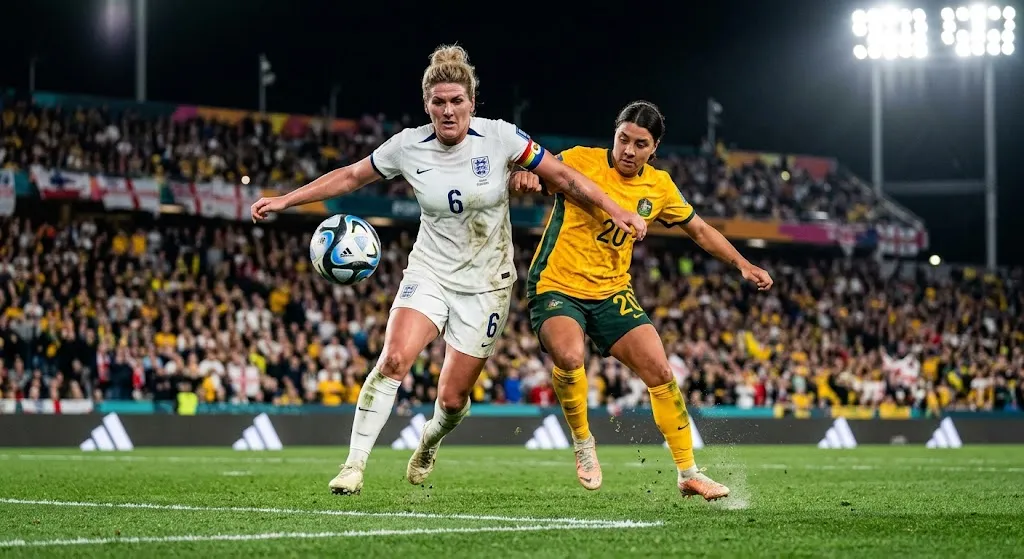
On August 16, 2023, Stadium Australia in Sydney hosted an electric semi-final in front of 75,784 spectators as European champions England took on tournament co-hosts Australia in the FIFA Women’s World Cup.
The Lionesses booked their first-ever World Cup final spot with a disciplined 3-1 victory, methodically neutralizing the home crowd through tactical composure, superior passing volume, and clinical attacking conversion.
Sarina Wiegman’s side struck first through an Ella Toone rocket before absorbing a sustained second-half push highlighted by Sam Kerr’s sensational equalizer. Rather than retreating under pressure, England adapted immediately, capitalizing on defensive mistakes with goals from Lauren Hemp and Alessia Russo to shut the door on the Matildas.
Match Overview Table
| Information | Match Details |
| Event | FIFA Women’s World Cup 2023 (Semi-Final) |
| Game | England vs Australia |
| Date | August 16, 2023 |
| Venue | Stadium Australia, Sydney |
| Attendance | 75,784 |
| Winner | England |
| Final Score | 3 – 1 |
| Broadcast | BBC One, ITV, Optus Sport, FOX Sports |
Core Match Statistics Overview
| Metric | England | Australia |
| Expected Goals (xG) | 1.82 | 1.15 |
| Possession % | 59% | 41% |
| Total Shots | 15 | 12 |
| Shots on Target | 5 | 4 |
| Passing Accuracy % | 83% | 73% |
| Total Passes Completed | 432 / 520 | 258 / 353 |
| Tackles Won (Success %) | 18 (67%) | 14 (58%) |
| Duels Won | 56 | 48 |
| Corners | 6 | 5 |
| Saves | 3 | 2 |
| Fouls Committed | 9 | 3 |
Expected Goals and Finishing Efficiency
- England generated 1.82 xG across 15 attempts, converting three of their five shots on target into goals (60% on-target conversion rate).
- Australia accumulated 1.15 xG across 12 attempts, but failed to capitalize on two prime scoring chances inside the six-yard box during second-half injury time.
Central Midfield Distribution
- England controlled central areas with 59% possession, completing 432 passes at an 83% accuracy rate to dictate the game‘s rhythm.
- Australia relied on direct, vertical passes toward wide channels, completing just 258 passes with a 73% completion rate.
Defensive Duels and Possession Recovery
- The Lionesses won 56 total ground and aerial duels, securing 18 successful tackles to break up Australian counter-attacks before they breached the penalty box.
- Australia secured 48 total duels and 14 tackles, struggling against England’s physical forward pairing in direct 1v1 situations.
Period-by-Period Analysis
First Half Breakdown
| Metric | England (1st Half) | Australia (1st Half) |
| Score | 1 | 0 |
| Possession % | 66% | 34% |
| Shots (On Target) | 7 (2) | 4 (1) |
| Expected Goals (xG) | 0.68 | 0.22 |
- England took immediate control of midfield spacing, pinning Australia inside their defensive third through aggressive counter-pressing by Georgia Stanway and Keira Walsh.
- In the 36th minute, Alessia Russo won a physical duel on the left baseline and cut the ball back to Ella Toone, who drove a clean strike into the top right corner.
- Australia created isolated counter-attacks through Mary Fowler and Sam Kerr, but Millie Bright and Alex Greenwood snuffed out direct passes over the top.
Second Half Breakdown
| Metric | England (2nd Half) | Australia (2nd Half) |
| Score | 2 | 1 |
| Possession % | 52% | 48% |
| Shots (On Target) | 8 (3) | 8 (3) |
| Expected Goals (xG) | 1.14 | 0.93 |
- Australia raised their line of confrontation after halftime, resulting in Sam Kerr’s remarkable 63rd-minute solo strike from 25 yards out to level the score at 1-1.
- England countered in the 71st minute as Lauren Hemp chased down a long ball, outmuscled Ellie Carpenter, and slotted the ball past Mackenzie Arnold.
- Alessia Russo ended the contest in the 86th minute by converting a no-look pass from Hemp with a low diagonal strike across the face of the goal.
Detailed Team Player Statistics
England Player Statistics
1. Lauren Hemp (Forward / England)
| Stat Metric | Output |
| Minutes Played | 90 |
| Goals / Assists | 1 / 1 |
| Shots (On Target) | 3 (2) |
| Key Passes | 2 |
| Successful Dribbles | 3 / 4 |
| Ground Duels Won | 7 / 11 |
Hemp delivered an elite attacking display, applying relentless pressure on Australia’s center-backs and capitalizing on a defensive error for England’s second goal. Her vision to set up Russo’s late finish closed out the win.
2. Alessia Russo (Forward / England)
| Stat Metric | Output |
| Minutes Played | 87 |
| Goals / Assists | 1 / 1 |
| Shots (On Target) | 4 (2) |
| Touches in Box | 8 |
| Aerial Duels Won | 4 / 6 |
| Tackles | 2 |
Russo served as England’s primary target, holding up possession under heavy physical contact and providing the assist for Toone’s opener. Her angled 86th-minute goal showcased high-level spatial awareness and finishing poise.
3. Ella Toone (Attacking Midfielder / England)
| Stat Metric | Output |
| Minutes Played | 90 |
| Goals | 1 |
| Shots (On Target) | 2 (1) |
| Pass Accuracy % | 86% (25/29) |
| Ball Recoveries | 5 |
Starting in place of the suspended Lauren James, Toone consistently exploited the pocket between Australia’s midfield and defensive lines. Her 36th-minute half-volley shifted early momentum completely to England.
4. Alex Greenwood (Center-Back / England)
| Stat Metric | Output |
| Minutes Played | 90 |
| Interceptions | 4 |
| Clearances | 6 |
| Long Balls Completed | 8 / 11 |
| Pass Accuracy % | 89% (68/76) |
Greenwood anchored the three-player backline with high-level ball distribution and precise positioning. She prevented Australian wingers from cutting inside and triggered England’s transitions with accurate long passes.
Australia Player Statistics
1. Sam Kerr (Forward / Australia)
| Stat Metric | Output |
| Minutes Played | 90 |
| Goals | 1 |
| Shots (On Target) | 5 (2) |
| xG Generated | 0.74 |
| Aerial Duels Won | 3 / 5 |
Kerr scored one of the tournament’s best individual goals from distance despite managing limited match fitness. However, two missed opportunities inside the box during the final ten minutes prevented a second Australian comeback.
2. Mary Fowler (Forward / Midfielder / Australia)
| Stat Metric | Output |
| Minutes Played | 90 |
| Key Passes | 3 |
| Pass Accuracy % | 79% (23/29) |
| Dribbles Completed | 4 / 5 |
| Ground Duels Won | 6 / 9 |
Fowler operated as Australia’s primary creative spark, finding small pockets of space to release runners into wide areas. She generated three key chances that threatened England’s backline in the second half.
3. Katrina Gorry (Midfielder / Australia)
| Stat Metric | Output |
| Minutes Played | 88 |
| Tackles Won | 5 / 7 |
| Interceptions | 3 |
| Total Passes | 44 |
| Fouls Won | 2 |
Gorry brought defensive intensity to the central third, consistently breaking up English passing combinations. Her ball-winning actions helped Australia stay within reach during England’s dominant possession spells.
4. Mackenzie Arnold (Goalkeeper / Australia)
| Stat Metric | Output |
| Minutes Played | 90 |
| Saves | 2 |
| Goals Conceded | 3 |
| Accurate Long Balls | 9 / 21 |
| Punches / High Claims | 1 / 1 |
Arnold had little opportunity to stop Toone’s top-corner strike or Russo’s low angled shot, but suffered a costly miscommunication with her backline on England’s decisive second goal.
Statistical Leaders Summary Table
| Category | England | Australia |
| Leading Scorer | Toone (1), Hemp (1), Russo (1) | Kerr (1) |
| Primary Playmaker (Assists / Key Passes) | Hemp (1 Assist, 2 Key Passes) | Fowler (3 Key Passes) |
| Top Defensive Disruptor (Tackles + Int) | Greenwood (4 Int, 2 Tackles) | Gorry (5 Tackles, 3 Int) |
| Most Accurate Passer (Min. 40 Passes) | Greenwood (89.5% on 76 Passes) | Catley (78.6% on 42 Passes) |
| Total Aerial Duels Won | Russo (4 Aerial Duels) | Kerr (3 Aerial Duels) |
Analytical Dissections: Reasons for Winning and Losing
The technical contrast in the england vs australia tactical battle showed up in transition efficiency and penalty-box execution.
Why England Won
Ruthless Transition Attacks
England targeted the wide spaces left behind Australia’s advanced full-backs, sending precise diagonal balls into the channels to generate immediate numerical advantages.
| Transition Metric | England | Australia |
| Fast Break Attacks | 4 | 2 |
| Shots from Fast Breaks | 4 | 2 |
| Fast Break Goals | 2 | 1 |
| Shot Conversion Rate % | 50% | 50% |
Lauren Hemp High-Press Impact
- Hemp contested every loose ball in Australia’s half, winning 7 ground duels and forcing turnovers in dangerous areas.
- Her aggressive pursuit of a routine clearance forced the miscommunication between Carpenter and Arnold for the winning goal.
Compact Defensive Structure
- England’s back three maintained tight spacing with midfielders Keira Walsh and Georgia Stanway, closing passing channels through the middle.
- This defensive discipline forced Australia into low-percentage crosses from wide positions rather than clean central combinations.
Why Australia Lost
Over-Reliance on Direct Attacks
Australia struggled to string together sustained sequences of possession, repeatedly attempting low-probability long balls forward. While Kerr’s individual brilliance produced an equalizer, the approach failed to create consistent pressure.
Defensive Miscommunication Under Pressure
- The decisive second goal stemmed from an unforced communication breakdown while defending a routine bouncing ball inside the box.
- Australia’s defensive line retreated too deep late in the second half, giving Russo and Hemp the space needed to manufacture the third goal.
Historical Context & Advanced Insights
England vs Australia Head-to-Head Series
| Date | Competition | Venue | Result |
| Aug 16, 2023 | FIFA Women’s World Cup Semi-Final | Sydney, AUS | England 3 – 1 Australia |
| Apr 11, 2023 | International Friendly | London, ENG | England 0 – 2 Australia |
| Oct 09, 2018 | International Friendly | London, ENG | England 1 – 1 Australia |
| Oct 27, 2015 | Yongchuan Cup Tournament | Chongqing, CHN | England 1 – 0 Australia |
The historical record in the england vs australia rivalry shows tight contests, but this semi-final marked the first competitive tournament meeting between the two sides on the global stage.
Advanced Statistical Insights
- Shot Quality Differential: Outside of Kerr’s long-range goal, Australia produced an xG of just 0.41 across their remaining 11 attempts, showing how effectively England restricted high-danger opportunities.
- Progressive Passing Volume: England recorded 48 progressive passes compared to Australia’s 26, proving that their possession actively gained territory and broke defensive lines.
- Turnover Capitalization: England scored two of their three goals directly from possession won in Australia’s half of the pitch.
Game Implications & Key Lessons
What This Means for England
- England reached their first-ever Senior FIFA Women’s World Cup Final, continuing an unprecedented era of tournament success under Sarina Wiegman.
- The team proved they can adapt their setup to win in hostile away environments without key suspended players.
What This Means for Australia
- The Matildas recorded their highest-ever World Cup finish (4th place), generating widespread cultural and commercial support for women’s football nationwide.
- Australia must develop more possession-based attacking patterns to avoid becoming one-dimensional against structured defensive teams.
Key Lessons
- Finishing quality outweighs shot volume: Capitalizing on high-probability chances consistently decides tournament knockout games.
- Defensive clarity prevents breakdowns: Basic communication errors can undo 90 minutes of competitive tactical work.
- Two-striker systems exploit flat backlines: The movement of Russo and Hemp created continuous matchup problems for Australia’s center-backs.
- Midfield tempo control saves energy: Controlling possession reduces defensive chasing over the course of 90 minutes.
- Individual wondergoals cannot substitute for collective attacking structure.